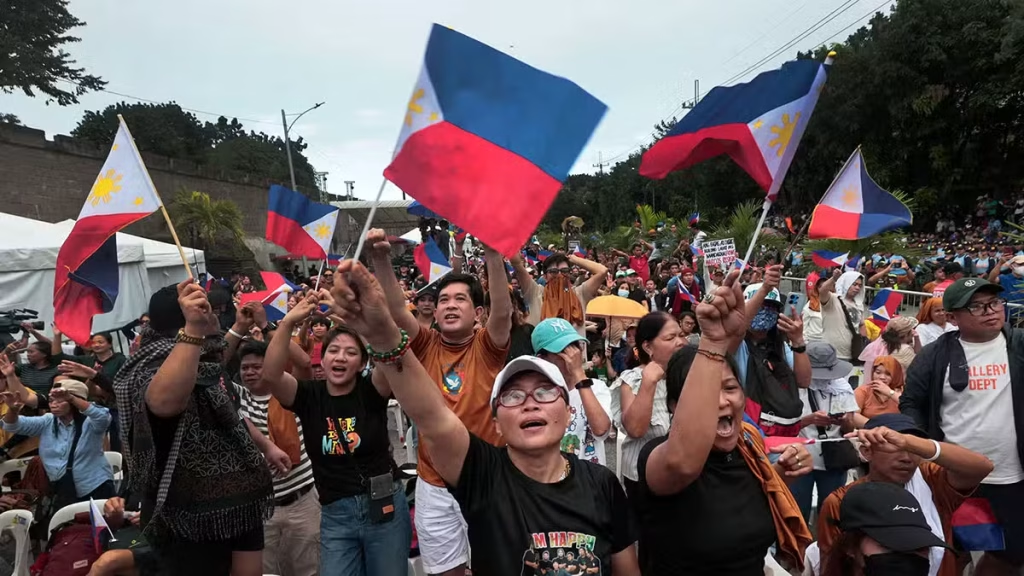
MANILA – With the echoes of last week’s fiery protests still ringing in the streets, progressive lawmakers are doubling down on the growing chorus demanding President Ferdinand Marcos Jr. and Vice President Sara Duterte resign, hailing it as a “legitimate” democratic lifeline amid a swirling storm of corruption allegations that’s eroding trust in the nation’s top brass. As two massive rallies gear up to flood Manila and Quezon City this weekend, the calls aren’t just chants – they’re a constitutional playbook for shaking up a leadership that’s lost its moral compass, activists argue.
The spark? A November 16 anti-Marcos rally at Quezon City’s People Power Monument, organized by the United People’s Initiative (UPI), where protesters didn’t hold back: Oust the president, and urge the Armed Forces of the Philippines to pull their support. That bold rhetoric landed in hot water fast, with the Department of the Interior and Local Government launching a probe into the speeches, branding them “close to inciting sedition.” Interior Secretary Jonvic Remulla didn’t sugarcoat it, while the Quezon City Police District vowed to dig deeper. But for the rally’s backers, it’s not rebellion – it’s raw accountability in the face of billions allegedly vanishing into shady infrastructure deals and budget black holes.
Enter the sequel: “Baha sa Luneta 2.0,” a nationwide wave of demonstrations set for November 30 at Manila’s Liwasang Bonifacio, spearheaded by the Makabayan bloc and a coalition of civil society heavyweights. They’re zeroing in on demands for crystal-clear probes into the graft mess, with some groups ramping up the heat by pushing outright for Marcos and Duterte to pack their bags. Running parallel? The “Trillion Peso March” back at the People Power Monument on Edsa, a nod to the eye-watering sums critics say have been squandered on flood control flops and ghost projects. Over 9,000 cops are already mobilizing to keep the peace, a sign that authorities are bracing for a turnout that could dwarf the last one.
Kabataan party-list Rep. Renee Co, a vocal rally organizer, laid it out plain: The 1987 Constitution has a contingency plan for exactly this kind of crisis. Citing Article VII, Section 10, she pointed to the smooth line of succession – from Senate president to House speaker – and the trigger for special elections if both top spots go vacant. “The Constitution is prepared for exactly these kinds of circumstances,” Co told reporters. “The framers contemplated the possibility of resignations, and they provided minimum steps that must be achieved.” Her bottom line? The rallies’ core cry is for a no-stone-unturned investigation into the scandals implicating Marcos and his inner circle, though she didn’t shy away from the bolder voices calling for the duo to step aside.
Echoing that fire is Raymond Palatino, secretary general of Bagong Alyansang Makabayan and a former Kabataan representative, who framed resignation as the ultimate democratic reset button. “Calls for resignation would be a perfectly legitimate, democratic and constitutionally contemplated remedy if the highest officials lose the moral authority and public trust required to govern,” Palatino declared. He zeroed in on Article VII, Section 8, which spells out resignation as a valid path to vacancy, complete with an “orderly mechanism” to keep the ship steady – think Congress calling the shots on special polls within 60 days. “The framers explicitly anticipated situations where a sitting president and vice president may no longer effectively lead the country,” he added. “They provided a peaceful, orderly mechanism for this eventuality.”
At the heart of the fury? A cascade of accusations tying Marcos and allies to overpriced flood defenses, rigged budgets, and procurement pitfalls that have left Filipinos drowning in both literal and figurative floods. For Palatino and Co, it’s not personal – it’s principled: When trust evaporates, the people get to demand a do-over, all baked into the charter that birthed the post-Marcos dictatorship era.
Yet as the weekend showdown nears, the air crackles with tension. Government probes into “sedition” could chill the streets, while the rallies risk tipping into chaos if tempers flare. For Marcos and Duterte, whose once-cozy alliance has frayed into open sniping, this isn’t just noise – it’s a litmus test for their grip on power. Will the calls fizzle into footnotes, or swell into a tidal wave that forces resignations and reshuffles the deck? With the capital’s icons set to host history’s next chapter, one thing’s clear: The people’s voice, once unleashed, doesn’t whisper.